Founding Proposal v0.3 · Part XIII
The founding process
Founding Proposal v0.3 · Part XIII · 5 min read
Open founding draft for collective examination. Not ratified.
Open from the beginning [Discussion 65]
Founding commitment. The development of The Fourth List shall itself be an open-source endeavour from the beginning. The first open-source project of The Fourth List will be The Fourth List itself.
| Develop first, open later | Open from the beginning |
|---|---|
| Greater initial coherence | Greater collective ownership |
| Faster initial decision-making | Broader examination of assumptions |
| Founders establish the architecture | Contributors collectively develop the architecture |
| People join an established initiative | People participate in establishing the initiative |
The second approach was explicitly chosen. The founding proposal must document decisions already made, their reasoning, alternatives and unresolved questions. It must be published as a proposal, not a finished constitution. The endeavour should demonstrate its own methodology through the process of its creation. This includes keeping its founders' proposals open to criticism, recording revisions and preserving reasons for change. The permanent purpose and charter proposed in this document are intended to be examined before adoption by communities.
Six founding outputs [Discussion 64]
| Proposed founding output | Purpose |
|---|---|
| Foundational Charter v1.0 | Document the permanent purpose and commitments after collective examination. |
| Open Protocol v0.1 | Establish and test initial standards for collective inquiry. |
| Open-source Platform v0.1 | Provide an initial digital implementation, not the exclusive implementation. |
| Community Handbook v0.1 | Enable anyone to establish an independent offline community. |
| Foundational Question Bank | Begin an evolving, interconnected research agenda. |
| Founding Assembly | Examine and improve the preceding outputs in light of actual inquiries. |
These are proposed operational outputs, distinct from the document development suite. The version numbers are illustrative and do not imply that a charter has been adopted or that software exists. The first assembly should be an opportunity to collectively develop the infrastructure, not simply announce it or debate philosophy. The existing six outputs are retained. As a proposed extension, the founding assembly should also examine the fourth-list methodology, the candidate commitments and a draft commitment record. It need not adopt or sign a declaration.
Seven foundational documents [Discussion 66]
| Document | Scope |
|---|---|
| 01. Founding Proposal | Purpose, vision, philosophical foundations and institutional architecture. |
| 02. Foundational Charter | Permanent purpose, commitments, rights and freedoms. |
| 03. Open Protocol | Standards for inquiry, dialogue, verification, documentation and interoperability. |
| 04. Governance Framework | Federation, institutional independence, distributed economics, freedom to fork and reconnect. |
| 05. Platform Architecture | Open-source software, knowledge graph, federation and AI integration. |
| 06. Community Handbook | Independent local communities, projects and assemblies. |
| 07. Foundational Question Bank | Initial questions, hypotheses, dependencies and emerging research directions. |
Each document should be independently versioned, openly licensed and publicly examinable. The four levels of documentation in Part X are conceptual distinctions; these seven documents are a practical initial development suite. The charter, protocol and handbook may evolve on different timescales. The question bank is not a finalized central research agenda. No specific open license has yet been selected. The seven-document suite remains intact. As a working proposal, a living Declaration of Human Commitments and associated record specification could be maintained as an additional resource, initially within the protocol, question bank and community handbook or as a separately versioned document after examination. It is not an adopted eighth founding document.
What we are building [Discussion 67]
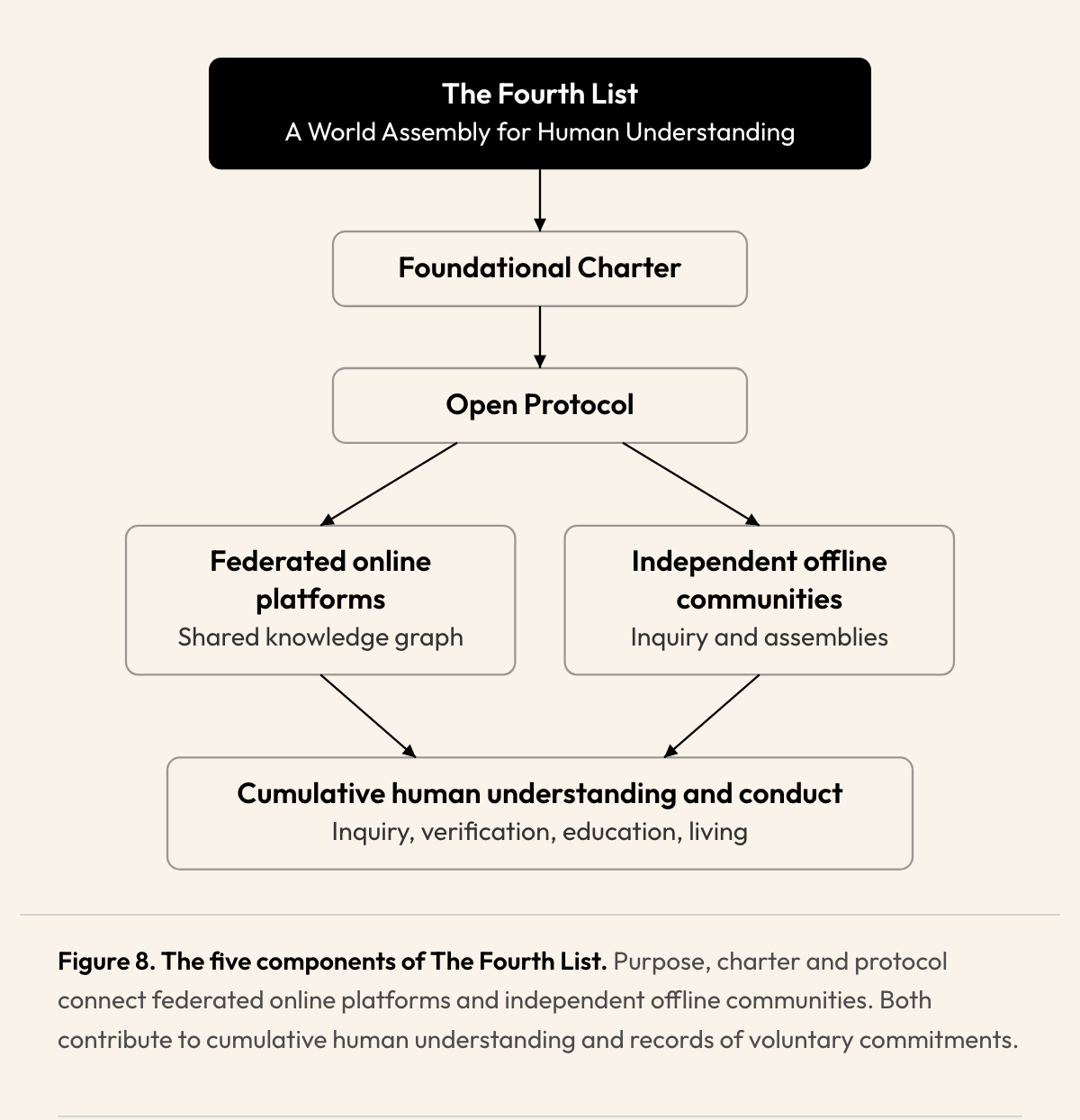
The architecture connects the purpose, charter, protocol, online platforms, offline communities and cumulative records of inquiry. The diagram is conceptual, not a hierarchical organization chart. Supporting organizations can contribute resources and maintain particular implementations without owning the charter, protocol or inquiry. A particular website, assembly or software implementation can cease while independent communities continue the endeavour.
A practical founding experiment
The initial presentation proposed international collaboration, not immediate venue booking. Philosophical design, global participation, dialogue and documentation, organizing and resources must all be developed. The first invitation is to help determine whether the proposed architecture should exist and to build it together. A practical pilot can test whether the methodology yields greater clarity than conventional discussion.
| Phase | Proposed scope and expected output |
|---|---|
| 1. Founding inquiry | An illustrative 8 to 12 diverse collaborators examine the proposal, identify assumptions and develop the methodology. |
| 2. Controlled pilot | An illustrative 20 to 30 participants examine approximately five questions, using the proposed methods and record format. |
| 3. Public review | Invite the wider international philosophical community to identify weaknesses, challenge findings and propose improvements. |
| 4. International assembly | Broader participation examines the tested architecture and begins formal records of findings. |
| 5. Continuing endeavour | Independent communities and projects maintain, test and advance inquiry between gatherings and across generations. |
The numbers and phases are working proposals, not recruitment quotas, dates or commitments. Success should be assessed by whether participants achieve greater mutual comprehension, precisely identify differences, develop clearer verification pathways and produce independently examinable records. More agreement alone is not success. The pilot should also test interoperability across independent groups, accessibility of methods, translation quality and the practicality of offline use. A proposed fourth-list pilot could examine a small number of conduct propositions, test the separation of assent and undertaking, document differing grounds and design a consent-based way to examine implementation. It should not be evaluated by the number of people persuaded to sign.
A possible practical sequence is to publish the founding proposal and a contribution process; form independent founding inquiry groups; develop a minimal protocol, reference repository and offline toolkit; conduct pilot inquiries across independent groups; publish and review findings and test record exchange; then convene a founding assembly to examine the results and improve the architecture. This sequence avoids making a global gathering a prerequisite for useful work.
Recommended next steps [Discussion 69]
- 1. Consolidate the full founding discussion in a comprehensive proposal. This v0.3 is that proposed reference, subject to review.
- 2. Extract a concise Foundational Charter, preserving the distinction between permanent purpose, commitments, hypotheses and methods.
- 3. Critically examine both documents for contradictions, hidden assumptions, institutional risks and unintended consequences.
- 4. Revise the original founding presentation to reflect the expanded vision and provide a concise invitation to collaborate.
- 5. Establish an initial public website and open repository with a visible contribution process and unresolved questions.
- 6. Invite initial international contributors across traditions, regions and forms of expertise.
- 7. Develop the protocol through actual philosophical inquiries, including offline trials and independent implementations.
- 8. Organize a founding assembly informed by the results of those inquiries.
These are recommendations, not a settled launch plan. No venue, participant list, budget, date, technical standard or binding resource commitment has been established. The seven-document suite, public introduction and proposed implementation sequence remain open to examination. The full historical discussion should be preserved separately as source material when a suitable transcript is available, rather than allowing future versions of the proposal to replace the historical record.
Read it offline: the book as a PDF or as Markdown.