Founding Proposal v0.3 · Part XV
Open questions and risks
Founding Proposal v0.3 · Part XV · 5 min read
Open founding draft for collective examination. Not ratified.
What remains genuinely undecided
This section preserves questions identified in the discussion and the subsequent completeness audit. These are not decisions accepted by the initial proposer. They should become initial inquiries into the architecture itself.
| Open question | Why it matters |
|---|---|
| What constitutes sufficient verification? | Independent reports do not necessarily establish truth. The criteria for a verification label must be examined. |
| How are different claim types examined? | Mathematical, empirical, metaphysical, ethical and experiential claims may require different standards. |
| What would count against H1 or H2? | The hypotheses about common reality and resolvability must remain examinable, including when findings oppose initial expectations. |
| How is global agreement represented? | Unanimity within one group is not unanimity across the network or humanity. |
| Can an agreement lose its status? | New evidence, objections, participants or changes of position may alter the current state of inquiry. |
| How is conceptual equivalence established? | Identical translations may conceal different meanings or philosophical contexts. |
| How are false or misleading contributions handled? | Permissionless inquiry needs standards of provenance, integrity, moderation and appeal without a central authority over truth. |
| Who determines protocol compatibility? | Compatibility assessment could become a new concentration of power or a barrier to independent communities. |
| How are methodological disagreements resolved? | The protocol must be capable of examining and improving itself, with open objections and alternatives. |
| How is common infrastructure sustained? | Distributed support may leave shared but unglamorous work underfunded and create unequal opportunities. |
| How is privacy protected in living demonstrations? | Private individual and family relationships must not automatically become public research records. |
| What happens if a foundational hypothesis is disproved? | The endeavour must accept contrary findings rather than protect its anticipated conclusions. |
| How does purpose survive institutional forks? | Freedom to diverge must be reconciled with clear, non-misleading identity and freedom to reconnect. |
| How are verification records assessed across communities? | Different methods, versions and evidentiary requirements may produce apparently conflicting status labels. |
| Who maintains reference specifications? | The network needs maintenance responsibility without exclusive control over the future of the protocol. |
| How are responsibilities earned and relinquished? | Contribution-based governance requires transparent entry, accountability, succession, removal and appeal. |
| How are operational deadlocks handled? | Practical decisions may require deadlines even when philosophical or methodological objections remain. |
| What licenses and legal arrangements are appropriate? | Open-source code, educational materials, documentation, data, identity and attribution may require distinct arrangements. |
| How should replicated records be corrected or withdrawn? | Traceability and federation create tensions with consent, privacy and correction of errors. |
| How should AI outputs be evaluated and disclosed? | AI may invent evidence, distort positions or obscure the human source of claims. |
| What is K4M2A's role? | Initiation and resource support must not become exclusive ownership or permanent philosophical authority. |
| How can progress be measured responsibly? | Metrics should reveal progress without encouraging inflated counts, superficial consensus or competitive ranking. |
| How can a founding charter remain protected yet examinable? | The permanence of purpose must not immunize its formulation or the founders' assumptions from scrutiny during founding. |
| How do we ensure safety and accessibility in participation? | Moderation, misconduct, discrimination, accessibility and practical support need transparent procedures. |
Additional open questions introduced by List Four
These questions arise from the renaming and extension. They are deliberately left open rather than silently settled on behalf of the proposer or future contributors.
| Question | Why it matters |
|---|---|
| What is the relationship between understanding reality and appropriate conduct? | Descriptive and normative claims require examination of their connection. |
| Minimum shared ethics or universally appropriate living? | The long-term research ambition remains to be collectively examined, without blocking voluntary interim commitments. |
| What is sufficient for inclusion in List Four? | Candidate, agreement, undertaking and demonstration are distinct; section 78 is unresolved. |
| How should positive responsibilities be formulated? | The twelve original candidates concern restraint; positive commitments require their own independent examination. |
| What do the candidate restraints mean in difficult cases? | Ambiguous definitions or exceptions could yield misleading consensus or commitments. |
| What constitutes adequate demonstration? | Isolated observations, self-report and sustained independent examination are not equivalent. |
| Can a person withdraw or revise a commitment? | Informed consent and version integrity must coexist with historical traceability. |
| How should conflicting undertakings be examined? | Different commitments may be incompatible in particular contexts, requiring further inquiry. |
| How should private evidence be protected across federated nodes? | Replication may undermine consent or expose family and other sensitive records. |
| How do organizations undertake commitments? | Organizational responsibility must not be confused with the individual understanding of members. |
| Who may describe a commitment as shared globally? | Local assent cannot be represented as a mandate from humanity. |
| How should a Declaration of Human Commitments be maintained? | Its exact place in the foundational document suite and the relationship between versions and forks remain open. |
| How do we avoid an instrument of moral ranking or coercion? | Independence of inquiry and voluntary participation must survive the new conduct architecture. |
Coherence of the accepted architecture
The major decisions are not isolated preferences. They are connected by the principle that understanding belongs to individuals while inquiry can be collective. If no institution can understand on behalf of another human being, independent inquiry requires freedom to examine claims. To cooperate across independent communities, the endeavour needs an open protocol. Federation allows communities to retain their records while making inquiry cumulative. Forking prevents exclusive control of the methodology; reconnecting prevents divergence from becoming needless fragmentation. Distributed support avoids reintroducing centralized control through finance. Open founding puts these commitments into practice in the creation of the endeavour itself.
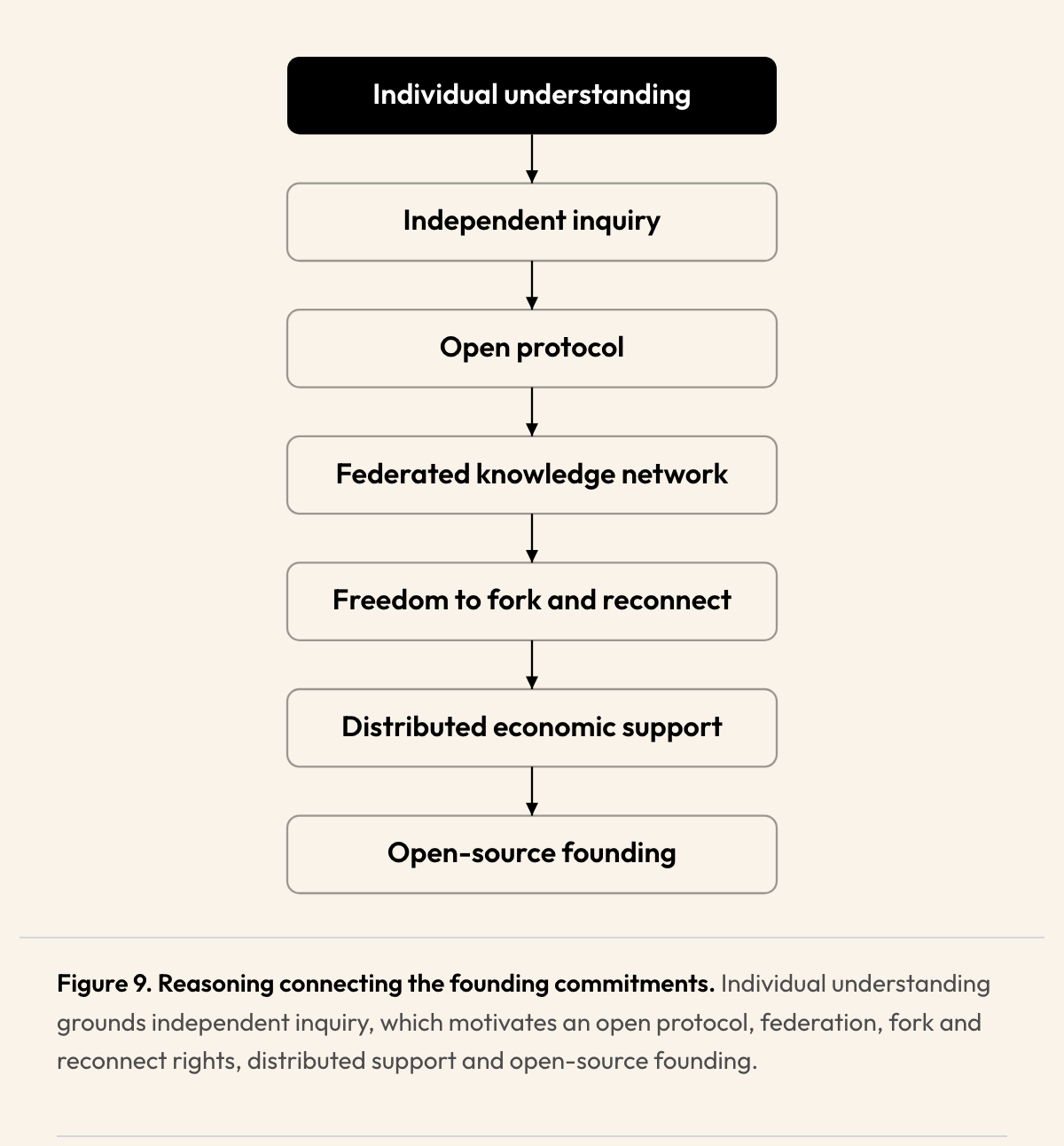
This is the rationale proposed in the discussion and expanded in the audit. The connections are not a claim that this architecture is the only possible implementation. Each should be examined for actual coherence, tradeoffs and unintended consequences. The founding proposal should itself be the first object of collective inquiry under its own principles.
Read it offline: the book as a PDF or as Markdown.