Founding Proposal v0.3 · Part III
Architecture of inquiry
Founding Proposal v0.3 · Part III · 10 min read
Open founding draft for collective examination. Not ratified.
Four lists, four distinct records [Discussion 09, 70–78]
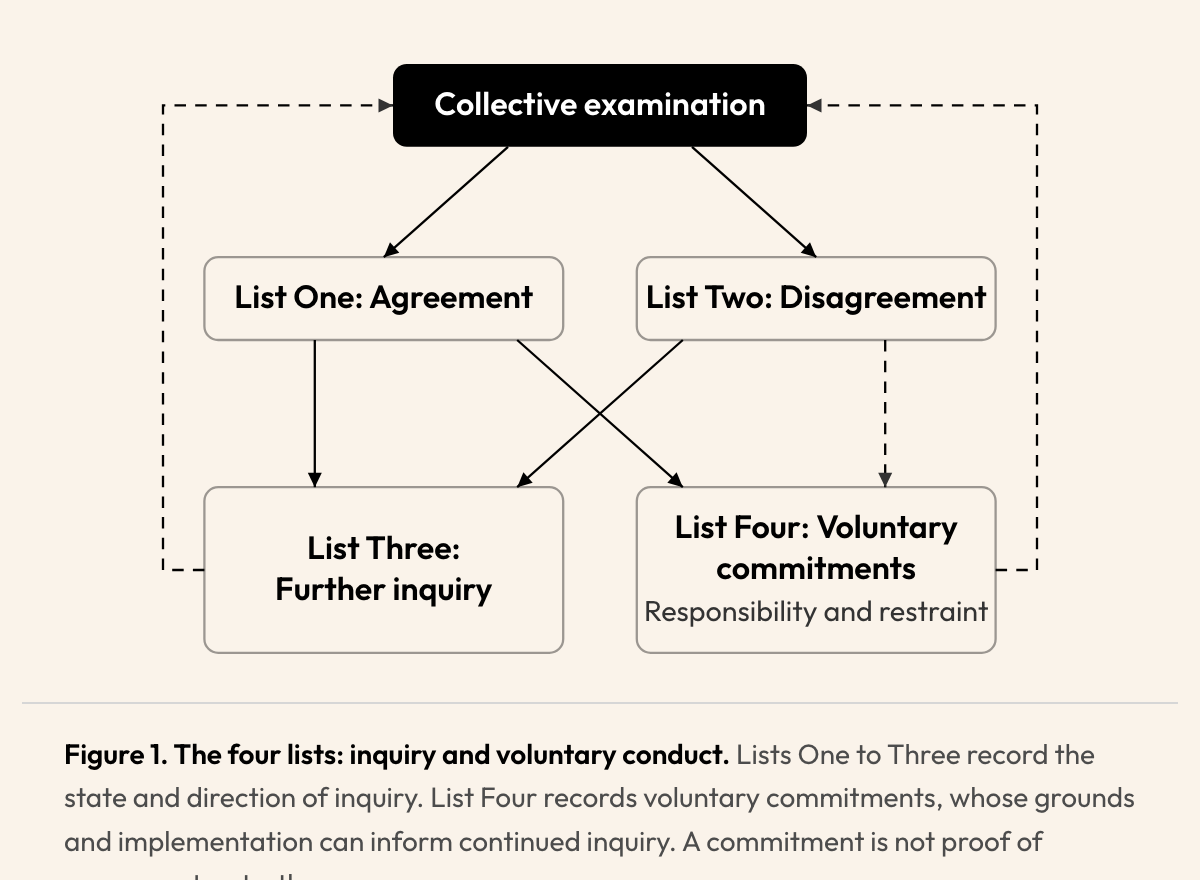
The original presentation described one gathering producing three honest records, not three conclusions. The revised architecture retains those three inquiry records and adds a fourth record concerned with human conduct. Each is a living, scoped record. None represents humanity as a whole or establishes truth by unanimity.
| List | Foundational question and purpose |
|---|---|
| 01. Agreement | What do we agree on? Record common ground. |
| 02. Disagreement | What do we not agree on? Identify unresolved differences in understanding. |
| 03. Inquiry | What do we need to understand together? Advance collective understanding. |
| 04. Commitment | What will we and what will we not do? Translate understanding into voluntary responsibility and restraint. |
The first three lists concern the state and direction of inquiry. The fourth concerns the relationship between understanding and conduct. The fourth does not replace the first three or make them subordinate to a predetermined ethical conclusion.
List One: What we agree on
A public record of propositions unanimously accepted by the identified participating signatories, at a specified version and scope. Each record should contain:
- The precise proposition and definitions of important terms.
- The participating signatories, scope and date of agreement.
- Each individual's grounds for agreement, including differing grounds where applicable.
- Methods through which the proposition may be independently examined.
- Current verification status and relevant supporting or challenging records.
- Revision history and any subsequent changes to the scope or status of agreement.
Unanimity describes the defined group. It does not mean all humanity agrees, nor does it prove a proposition true. A community can agree on a proposition for different reasons. A record must not obscure such differences. How agreements remain accurate when new contributors arrive, withdraw or challenge a proposition remains open.
List Two: What we do not agree on
A public record of unresolved philosophical differences. Each record should contain the precise point of disagreement, the distinct positions, their supporting grounds and assumptions, relevant observations and terminology, and what would be required to advance the inquiry. Distinguish disagreement from uncertainty or lack of a position. Minority positions must not disappear because most participants reject them. The objective is not to archive opposing opinions as an end in itself but to understand why they diverge.
List Three: What we need to understand together
The third list is a living collective research agenda. The original phrase, What we need to agree on, was proposed for revision because understanding is the objective and agreement is an outcome, not an obligation. The working wording is What we need to understand together. Each record should include the question, why its resolution matters, dependencies on other questions, existing attempts, ongoing investigations and possible methods of inquiry.
The third list is the driving force of the research endeavour: the first two lists describe the present state of inquiry; the third directs attention to its future. A disagreement can simultaneously be on List Two and List Three, and a question may remain important after partial agreement. The lists are not mutually exclusive buckets. The original three-list mechanism remains intact within the four-list architecture. The detailed mechanisms for all four lists are working designs for contributors to refine.
List Four: What we will do and what we will not do
The fourth list is a living record of shared human commitments. It includes both responsibility (what participating people voluntarily undertake) and restraint (what they voluntarily refuse to undertake). A commitment may be shared before all philosophical disagreements are resolved. Its underlying claims may remain in Lists One, Two or Three. Signing a commitment does not verify its grounds or establish that it has been fulfilled.
The shift from a parallel record of commitments to a fourth list was explicitly initiated by the proposer. Part IX develops its philosophical purpose, candidate commitments, and proposed Declaration of Human Commitments. The exact eligibility and evidence requirements for inclusion in List Four are open. The record should distinguish acceptance of a proposition, acceptance of responsibility and observed conduct over time rather than reduce these to a single signature.
The response mechanism
The original presentation proposed a clear proposition, private written Yes or No answers, examination of reasons and documentation. Recording an independent initial position can reduce conformity and deference to prominent participants. However, ambiguous or conditional answers cannot be represented accurately by forced binary choices. The proposed expanded response set is:
| Response | Meaning |
|---|---|
| Yes | I accept the proposition. |
| No | I reject the proposition. |
| Undetermined | I have not reached a conclusion. |
| Conditional | My answer depends on stated conditions. |
| Needs clarification | The proposition is insufficiently defined. |
For example, Can human beings know the nature of reality? may receive a qualified yes, a yes under certain conditions, a no if knowing means complete knowledge, a request to define reality or an honest statement of uncertainty. Forcing these into Yes or No can manufacture false agreement or disagreement. Participants should record grounds and have the opportunity to reassess their answers after inquiry. If wording is ambiguous, revise it and preserve the version history. Revisions motivated by better understanding should be treated as progress.
For the fourth list, a response to a normative proposition and a voluntary undertaking are separate records. A person can agree that a practice is inappropriate without yet undertaking a commitment; another can make a conditional commitment with a clearly specified scope. An absence of a signature is not automatically a disagreement. The existing response categories and independent reassessment process still apply to examining the underlying claims.
Interconnected questions [Discussion 10]
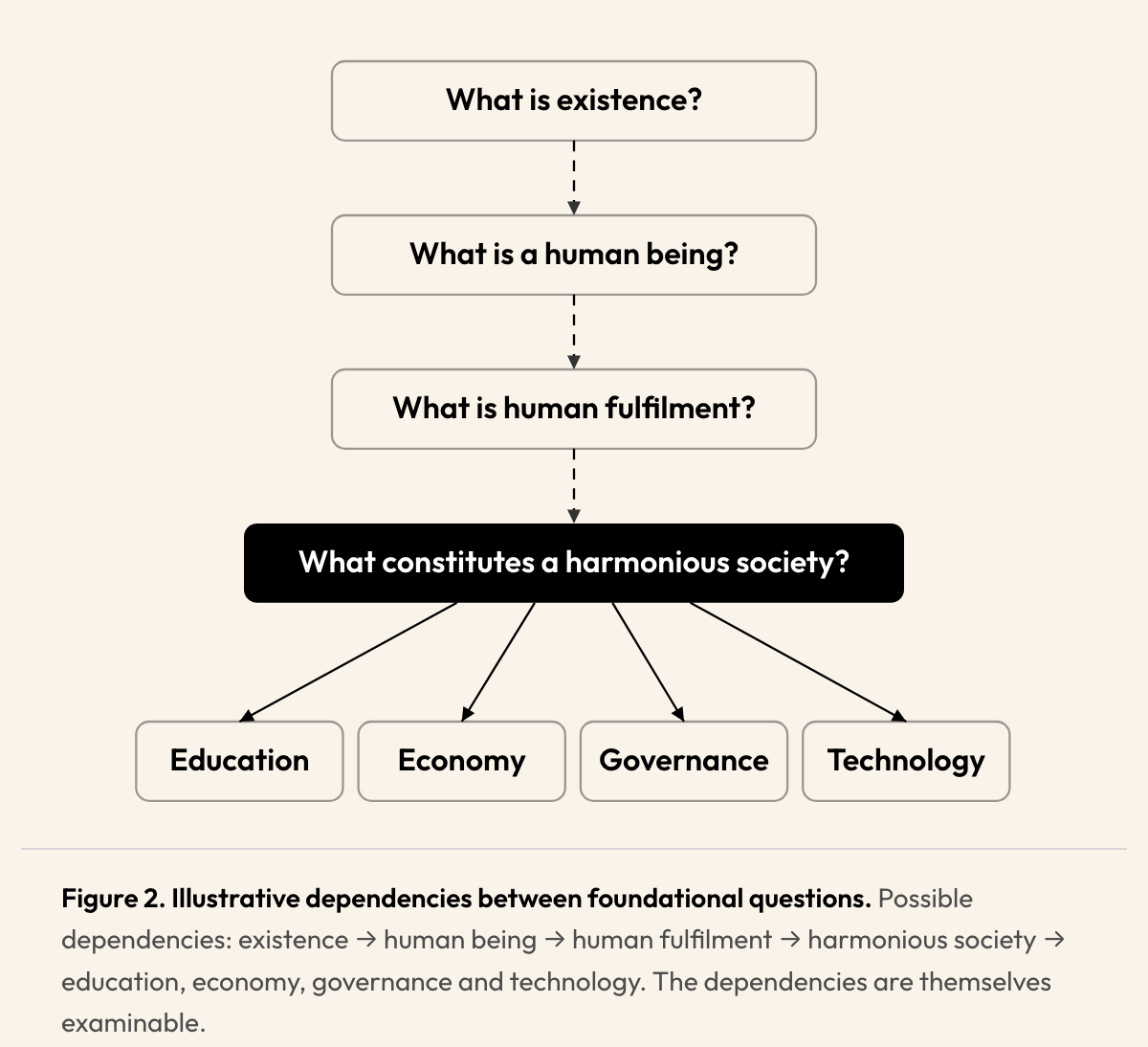
Founding commitment. Maintain a living architecture of foundational questions, identifying their interdependencies and the sequence in which they may need to be resolved. Some questions may depend on others: education may depend on what humans are capable of becoming; economics may depend on the meaning of human needs and prosperity. The dependencies are themselves open to examination. The resulting knowledge graph is more useful than a flat numbered list because it can show where resolving one question may advance many others.
Prioritization criteria [Discussion 11]
No central authority should assign research priorities. The proposed criteria help contributors identify where work may be meaningful; they are not a mandatory scoring system.
| Criterion | Question to examine |
|---|---|
| Foundational significance | How many or which other questions depend on this question? |
| Universal relevance | Does it concern human beings irrespective of culture, geography or belief? |
| Consequences for living | Would its resolution materially change human living or institutions? |
| Present understanding | What has already been investigated, and what is still unknown? |
| Possibility of investigation | Are there identifiable paths for advancing understanding? |
Philosophical significance must not be confused with immediate urgency. The nature of consciousness may have far-reaching consequences even if AI governance appears more immediately pressing. These criteria should inform a contributor's choice, not restrict the freedom to investigate.
Complete systems and individual propositions [Discussion 13]
Founding commitment. Facilitate the examination of both complete philosophical systems and individual propositions while preserving their relationships.
Individual propositions enable people from different traditions to examine shared questions without accepting an entire system. However, removing a claim from its original context may distort its meaning, and a system's internal relationships may be important to its explanatory claims. Examining only entire systems preserves their architecture but makes joint investigation and comparison unwieldy. Both forms must coexist.
A system may present its understanding of reality, concepts, propositions, their dependencies and its proposed methods of verification. Individual propositions can then be examined separately while their original context is retained. Participants need not accept the entire system to examine a particular claim. No system is accepted or rejected solely on the basis of origin, historical significance, institutional status or popularity. Internal coherence and correspondence to reality are distinct questions.
Seven-stage architecture of dialogue [Discussion 14]
A debate may reward defending a position. The proposed dialogue process aims instead at understanding and examination.
- 1. Independent position: Each person records their present understanding and grounds before collective discussion.
- 2. Mutual comprehension: Participants articulate the other person's position until that person confirms it has been sufficiently understood.
- 3. Identification of differences: Establish exactly where propositions, meanings, observations or conclusions diverge.
- 4. Identification of foundations: Examine definitions, assumptions, reasoning, observations and proposed methods underlying each position.
- 5. Collective examination: Investigate competing claims through appropriate methods of verification. Record missing evidence where immediate resolution is not possible.
- 6. Independent reassessment: Each participant determines whether their understanding has changed and why, without pressure to agree.
- 7. Documentation: Record what has been understood, clarified, agreed upon, independently examined and what remains unresolved.
A dialogue may span multiple meetings, years of study, experiments or lived demonstration. The institution must accommodate this duration. It should not require every dialogue to end in a vote or resolution.
Cumulative inquiry [Discussion 15]
Every subsequent inquiry should be able to build on prior work. Preserve the questions already examined, arguments already considered, misunderstandings already clarified, methods of verification already attempted, reasons for changed understanding and remaining obstacles to resolution. This is a collective memory not only of conclusions but of how understanding develops across individuals, institutions and generations. A later inquiry may repeat a test where necessary, but should be able to discover why it is repeating it.
Pathways to understanding [Discussion 16]
Founding commitment. Develop and document pathways through which another human being can independently examine and verify philosophical claims.
A contribution should distinguish the understanding asserted from the process by which another person may arrive at it. A claim without an established pathway may be documented as a hypothesis rather than verified knowledge. This is not a rule excluding new ideas; it is a rule for representing their status accurately.
| Contribution field | Question to answer |
|---|---|
| Understanding | What do you claim to understand? |
| Grounds | On what basis do you make this claim? |
| Process | How did you arrive at this understanding? |
| Verification | How can another person independently examine it? |
| Conditions | Are there prerequisites, definitions or contextual conditions? |
| Limitations | What remains outside the claim or is still unresolved? |
The record should also identify potential contrary observations, expected findings and the relationship to existing inquiry. Standards for evaluating a pathway must be developed openly. A philosopher's contribution is not merely an explanation of reality, but potentially a means for other humans to examine it independently.
Status of understanding [Discussion 17]
The following seven statuses are proposed. They distinguish questions from hypotheses and preserve the difference between a claim, a pathway and a verification record.
| Status | Meaning |
|---|---|
| Question | Something has been identified for investigation. |
| Hypothesis | A possible explanation awaits verification. |
| Articulated understanding | A person claims understanding and provides grounds. |
| Examinable understanding | A pathway for independent examination has been established or documented for assessment. |
| Independently verified | Multiple people report independent verification through documented methods, subject to examination of those reports. |
| Universally verifiable | Sufficient grounds are proposed for considering a pathway universally accessible, subject to continued examination and stated conditions. |
| Challenged | A substantive objection or contrary observation requires further inquiry. |
These are not necessarily linear stages, nor do labels prove the truth of a claim. A challenged proposition may already have prior verification records; the challenge must be preserved rather than erase history. Exact criteria for these labels and their scope remain open. The status of a question, the status of a proposition, and the status of its verification records may need to be represented separately in the protocol.
Procedural authority, not authority over truth [Discussion 18]
| Approach to declaring resolution | Limitation |
|---|---|
| Majority voting | Popularity does not establish truth. |
| Unanimous agreement | Agreement does not establish verification. |
| Expert committee | Expertise does not guarantee understanding or establish a conclusion on another person's behalf. |
| Distributed independent verification | Preserves individual responsibility but requires rigorous, transparent standards. |
The working recommendation is distributed independent verification. Each person is responsible for their own examination; the network records who has verified what, by what method and under what conditions; substantive objections remain available; committees or maintainers administer standards rather than determine philosophical truth. No proposition becomes immune to examination. The precise evidence and standards required for a status label remain unresolved. Operational governance can adopt a protocol version without declaring a philosophical question resolved.
Read it offline: the book as a PDF or as Markdown.