Founding Proposal v0.3 · Part VI
Federated digital infrastructure
Founding Proposal v0.3 · Part VI · 5 min read
Open founding draft for collective examination. Not ratified.
Global network [Discussion 41]
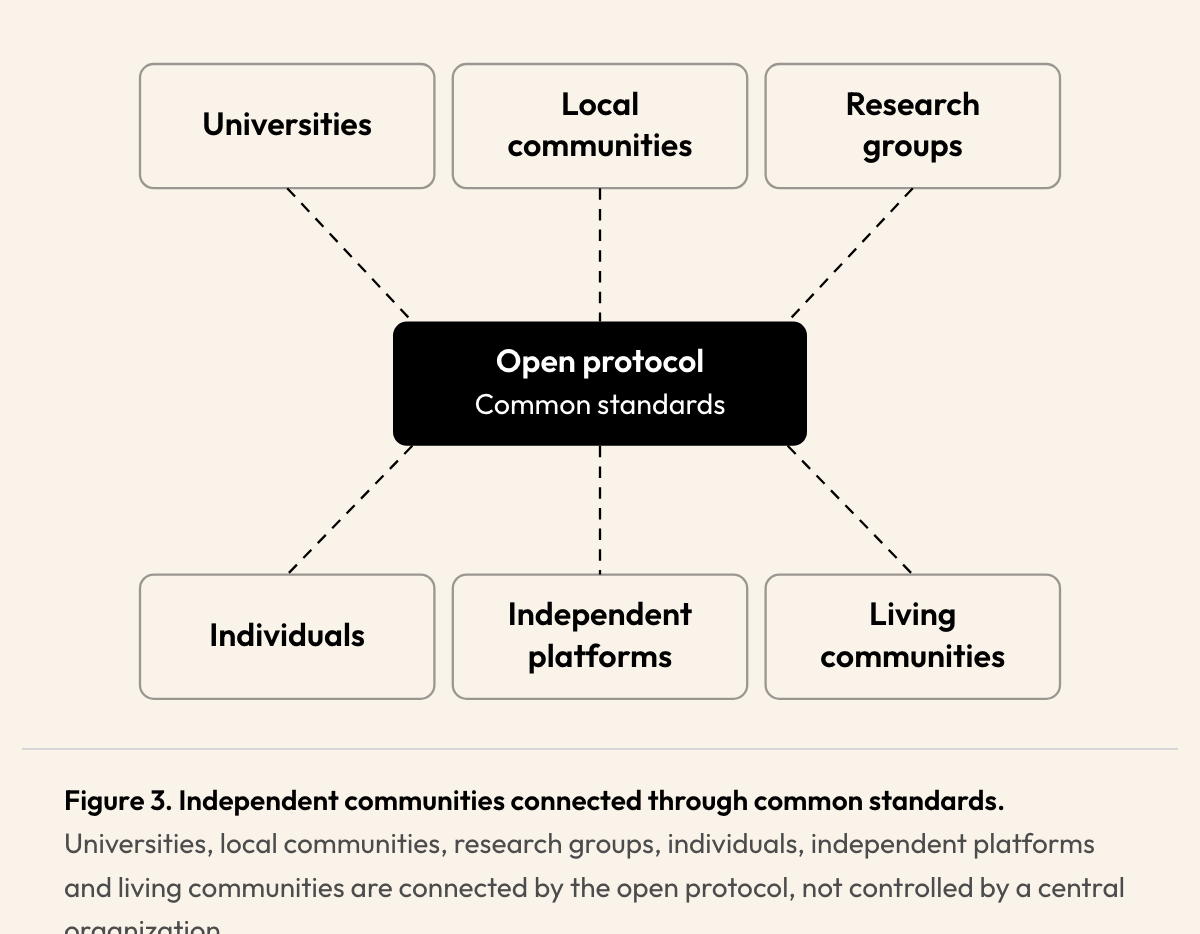
Individuals, universities, research groups, local communities, living communities and independent digital platforms should be able to work through common standards without being controlled by a central institution. A university in Japan, a family community in India, a research group in Germany and an independent philosopher in Brazil may conduct independent inquiries with different tools and still contribute to a shared body of records. Supporting organizations can facilitate these activities without representing or owning the philosophical understanding of the participants.
Architectural alternatives [Discussion 43]
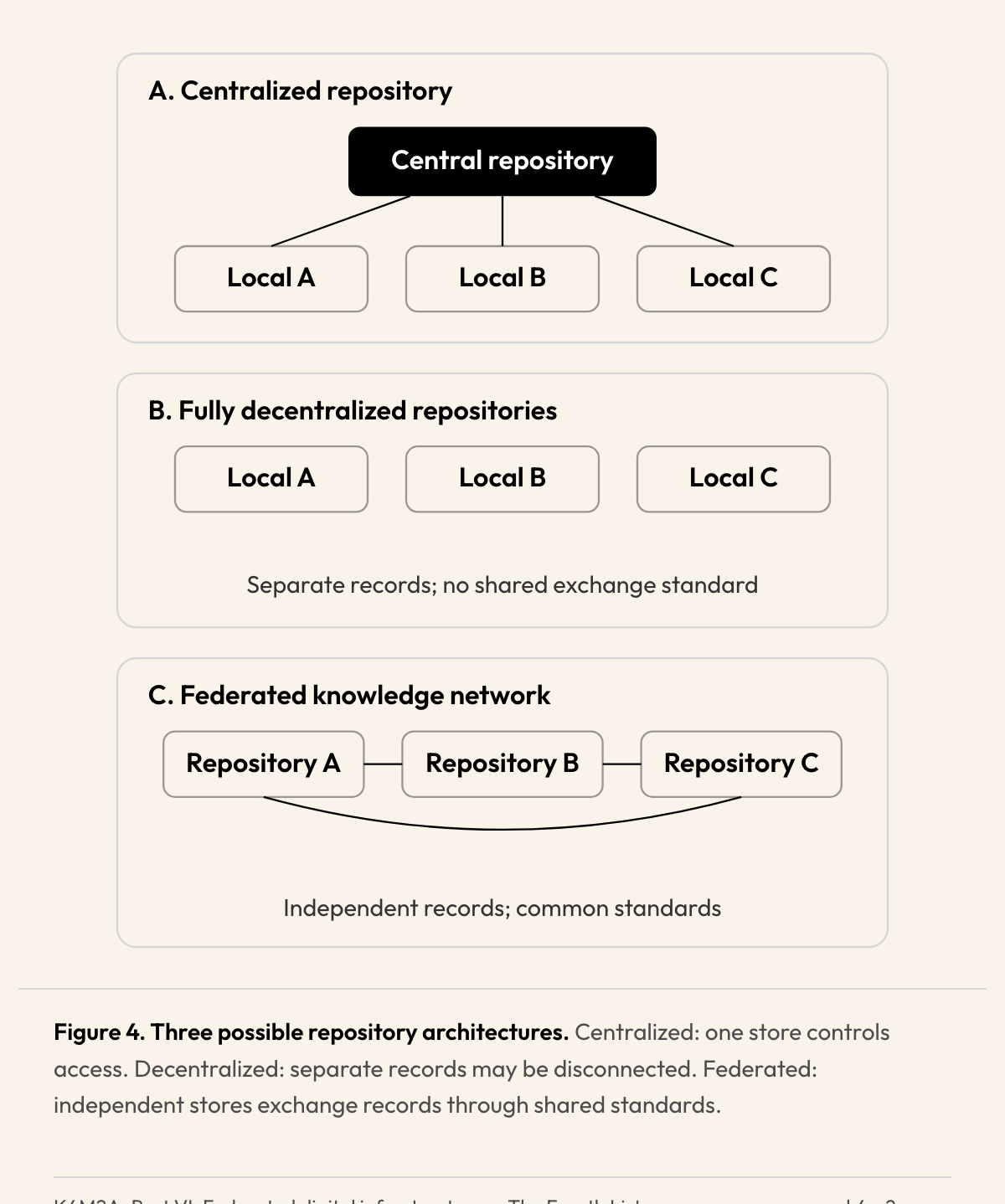
| Model | Advantage and limitation |
|---|---|
| A. Centralized repository | One global repository simplifies common indexing and coherent record keeping, but concentrates institutional power and creates a single dependency. |
| B. Fully decentralized repositories | Independent communities maximize local autonomy, but incompatible records can fragment inquiry and duplicate work. |
| C. Federated knowledge network | Independent repositories use common standards to exchange, discover and connect records, preserving autonomy while supporting cumulative inquiry. Coordination and interoperability still require careful design. |
Federated global knowledge network [Discussion 44]
Founding commitment. Develop a federated global knowledge network, allowing independent communities to maintain their own records while collectively advancing a shared architecture of human understanding.
The shared knowledge graph is a common resource, not a central authority. Communities may use different methods, languages, technologies and philosophical positions. They may examine the same question and reach different conclusions. The network should help them discover each other's work, examine differences, identify common grounds and cooperate towards resolution without requiring uniformity. The infrastructure should enable convergence where understanding supports it, not enforce convergence as a condition of membership. Over time the aim is an interconnected map of human understanding and the boundaries of what remains unresolved.
The design does not prescribe one global database or technical topology. The shared architecture could be implemented through independent repositories, multiple indexes and exchange services. Decisions on hosting, identity, record synchronization, trust, compatibility and federation remain open. The platform should not become an authority over philosophical truth through control of search, rankings, labels or visibility.
Online and offline as complementary environments [Discussion 30, 33]
| Online open-source platform | Offline open-source platform |
|---|---|
| Global question repository | Local inquiry groups |
| Repository of philosophical systems | Philosophical study circles |
| Collaborative examination of propositions | In-person philosophical dialogues |
| Documentation of independent verification | Practical demonstrations through living |
| Collaborative translation | Local educational initiatives |
| AI-assisted inquiry | Regional and world assemblies |
| Public history of evolving understanding | Independent research communities |
Neither environment is subordinate to the other. Online infrastructure provides continuity, discoverability and collective memory. Offline communities enable sustained human interaction, relationships, observation, independent study and lived verification. The shared protocol should work in both contexts. People need not obtain a platform account or central approval to undertake local inquiry.
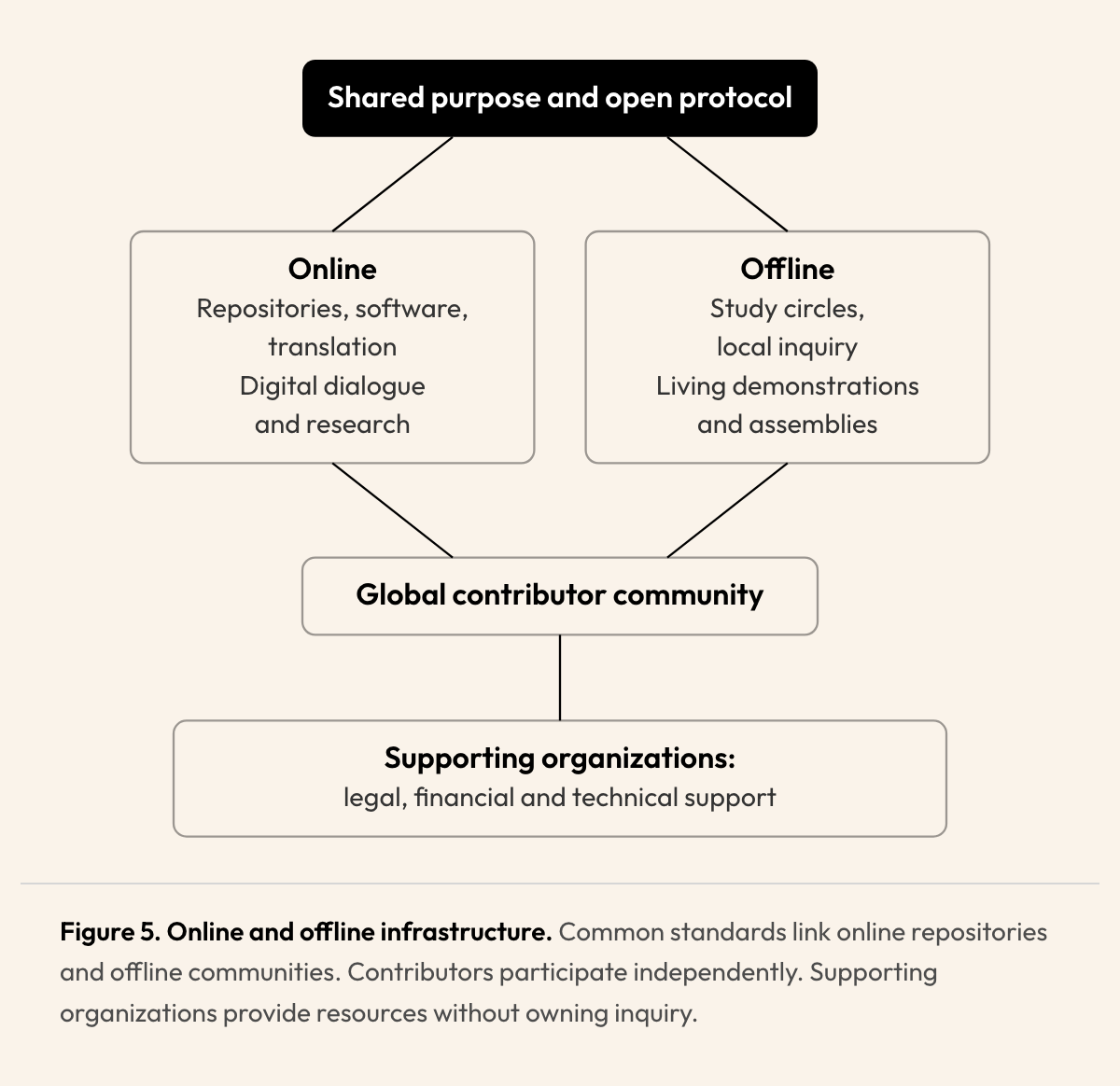
The figure represents shared purpose and a common protocol linking independent activities, not a hierarchy of command. A supporting foundation, if established, would provide legal, financial and technical infrastructure to relevant activities. It would not own the inquiry.
The role of AI [Discussion 62]
Founding commitment. AI shall be an integral but non-authoritative layer of The Fourth List, with independent human understanding and verification remaining central to the entire endeavour.
AI can help manage the scale and complexity of collective inquiry. The following eight domains were proposed:
| Domain | Possible role |
|---|---|
| Philosophical mapping | Identify relationships between questions, concepts and systems for human review. |
| Contradiction discovery | Surface potentially incompatible propositions and assumptions, distinguishing apparent from genuine contradictions. |
| Translation | Facilitate communication across languages and philosophical vocabularies; preserve contested meanings. |
| Collective memory | Retrieve previous inquiries, observations and objections so participants need not start again from scratch. |
| Dialogue | Assist participants in accurately understanding each other's positions without deciding which is true. |
| Education | Adapt explanations and pathways to a person's current comprehension and needs. |
| Verification | Assist in proposing methods of examination and identifying missing evidence or possible counterexamples. |
| Coordination | Connect independent contributors investigating related questions. |
AI-generated interpretations, translations, proposed contradictions and conclusions must remain distinguishable from human-authored contributions and independent verification records. AI can misrepresent traditions, introduce bias, fabricate evidence or generate an apparent agreement that does not correspond to understanding. Such outputs require appropriate traceability and human examination. No AI provider, model or commercial organization should become indispensable to the protocol. Communities may use their own AI systems, or participate offline or without AI. Detailed evaluation, disclosure, consent and privacy standards remain to be developed.
AI and the fourth list
AI may help identify potentially related commitments, compare their wording, surface conflicts between a stated commitment and available evidence, translate records, and suggest questions or methods of examination. These are assistance functions, not determinations of whether a person has fulfilled a commitment. AI must not sign on behalf of a human being, generate fictitious endorsements, infer moral status from private communications, manufacture evidence of conduct or turn a commitment into an automated reputation score. Consent, human review, data minimization and the separation of AI-generated suggestions from verification records are especially important here. These are proposed implementation safeguards, subject to examination.
Read it offline: the book as a PDF or as Markdown.