Founding Proposal v0.3 · Part IX
Education and human living
Founding Proposal v0.3 · Part IX · 12 min read
Open founding draft for collective examination. Not ratified.
Universal accessibility [Discussion 19]
Founding commitment. The Fourth List should not merely investigate whether universal understanding is possible. It should progressively make that understanding accessible to every human being.
| Permanent responsibility proposed | Purpose |
|---|---|
| Investigation | Advance human understanding of reality. |
| Verification | Develop pathways for independent examination. |
| Documentation | Preserve cumulative records of inquiry and understanding. |
| Education | Enable humans to independently arrive at understanding rather than merely receive conclusions. |
| Accessibility | Remove linguistic, economic, geographical and educational barriers. |
The educational responsibility follows from the distinction between individual understanding and collective inquiry. An explanation or a translated statement may help a person examine a claim, but neither establishes that the person understands it. Educational pathways should include the grounds, relevant observations, prerequisites, independent examinations and limitations. They should be available in accessible formats, at different levels of complexity, across languages and without requiring adherence to a philosophical doctrine. AI may facilitate personalized inquiry but must not replace the learner's own understanding.
Open public access to knowledge, open educational resources, translations and intergenerational transmission are part of the proposed design. Understanding and its shared pathways should not become proprietary resources whose accessibility is determined by ability to pay. Independent educators and communities should be able to adapt educational methods to local needs and contribute improvements. Whether a pathway is actually accessible must itself be examined, not inferred from publishing it online.
Institutional models [Discussion 20]
| Model | Responsibility |
|---|---|
| Research institution | Investigate, verify and publish understanding. |
| Research and education institution | Additionally develop pathways through which others can independently arrive at understanding. |
| Research, education and demonstration institution | Additionally facilitate and examine the implications of understanding in living. |
The third model was recommended and the principle of demonstration through living was explicitly accepted. This does not mean a centralized institution prescribes how others must live. It means claims concerning human living remain open to examination in the domain to which they apply. Investigation, verification, education and living can inform one another continuously. Observations arising through lived demonstration may support, qualify or challenge philosophical claims and lead to further inquiry.
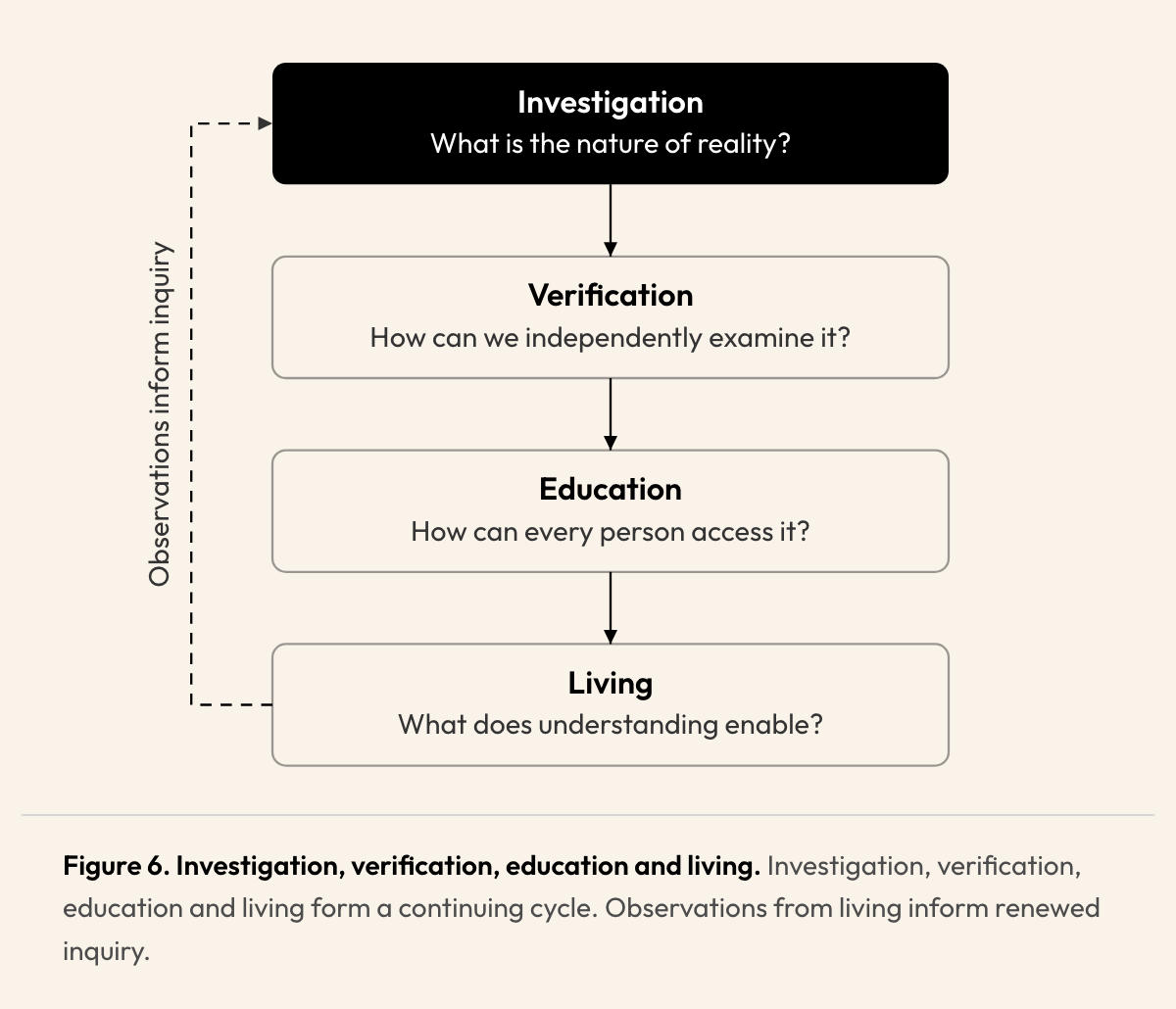
Demonstration through living [Discussion 21]
Founding commitment. Where an understanding makes claims about human living, its examination remains incomplete until its implications have also been examined through living.
| Domain | Illustrative area of examination |
|---|---|
| Individual human living | Whether claimed implications for understanding, happiness and behaviour are observable over time. |
| Family and relationships | Whether claims concerning trust, respect and harmonious relationships can be independently examined in everyday living. |
| Education | Whether educational pathways actually facilitate understanding rather than memorization or adherence. |
| Production and exchange | How claims about needs, prosperity and economic relationships bear on actual activities. |
| Society and governance | How propositions about coexistence and institutional relationships apply in lived social arrangements. |
| Humanity and nature | How understanding of our relationship with nature bears on real ecological interactions. |
| Science and technology | How understanding guides the development and use of technical capabilities, including AI. |
These illustrations extend the seven original domains without prescribing specific outcomes. Demonstrations should be voluntary, context-sensitive and open to evidence contrary to the original claim. They may require years of sustained observation, not just a single successful encounter. Methods for distinguishing causation from correlation, examining longitudinal findings, protecting participants and reporting contradictory observations are open design questions. Families, communities or individuals must not be pressured to expose private relationships or adopt a predetermined lifestyle. The initiative is not a political, religious or ideological movement. It facilitates examination rather than enforcing conduct.
Collective human commitments: the fourth list [Discussion 70–78]
Four dimensions of the endeavour [Discussion 70]
The question introduced by the proposer was whether humanity should also align on what it will not do. Humanity may not have reached agreement on an ideal society, but participants can investigate whether there are things no human being, organization or nation should undertake. Technological capability can expand independently of understanding about its appropriate use. This is a reason to investigate restraint as well as positive responsibility, rather than wait for every metaphysical question to be resolved.
| Dimension | Fundamental question |
|---|---|
| Understanding | What can humanity establish as universally verifiable? |
| Aspiration | What does humanity collectively want to achieve? |
| Commitment | What are we willing to undertake together? |
| Restraint | What are we collectively unwilling to do? |
These dimensions are not four new philosophical conclusions or four stages of proof. They describe different questions that may be examined in relation to one another. The first three lists organize inquiry; the fourth gives responsibility and restraint a distinct record.
Candidate restraints [Discussion 71]
The following twelve statements are preserved from the discussion as initial candidates for collective examination. None is represented as a commitment adopted by the founder, by a community or by humanity as a whole. Precise definitions, grounds, limits, difficult cases and implications must be examined before any voluntary undertaking is recorded.
| Domain | Candidate commitment for examination |
|---|---|
| Human dignity | We will not treat another human being merely as a resource for our own benefit. |
| Conflict | We will not initiate violence as a means of resolving differences in understanding. |
| Prosperity | We will not pursue our prosperity through the deprivation of others. |
| Nature | We will not knowingly destroy the conditions necessary for life on Earth. |
| Knowledge | We will not knowingly present belief as verified knowledge. |
| Freedom | We will not compel another human being to accept a philosophical or religious belief. |
| Education | We will not deliberately prevent another human being from developing their capacity to understand. |
| Economics | We will not build economic systems whose success depends on human suffering or exploitation. |
| Technology | We will not develop technologies without examining their consequences for humanity and nature. |
| Governance | We will not treat power as evidence of correctness. |
| Future generations | We will not pursue present benefits by knowingly compromising the ability of future generations to live well. |
| Artificial intelligence | We will not surrender human responsibility for decisions merely because machines can make them. |
These are starting formulations rather than enforceable rules. For example, the meaning of initiating violence, the distinction between deprivation and trade-offs, what counts as knowingly causing harm, and how responsibility relates to delegation require further examination. The initiative must not silently resolve those ambiguities through drafting. A candidate may be revised, narrowed, rejected or replaced through inquiry. The original wording and grounds for revisions should remain traceable.
Responsibility and restraint as complementary dimensions [Discussion 77]
The proposed two-part structure of the fourth list is preserved below. The entries are organizing questions, not settled obligations. Independent contributors should be free to formulate positive commitments as well as restraints, rather than simply invert a prohibition and assume that the resulting statement is universally appropriate.
| Domain | Paired questions for examination |
|---|---|
| Human relationships | Responsibility: What will we do for one another? Restraint: What will we not do to one another? |
| Nature | Responsibility: What will we do to enrich nature? Restraint: What will we not do to degrade nature? |
| Knowledge | Responsibility: What will we do to advance understanding? Restraint: What will we not do to obstruct understanding? |
| Technology | Responsibility: What will we develop? Restraint: What will we refuse to develop? |
| Economy | Responsibility: How will we create prosperity? Restraint: How will we refuse to create wealth? |
| Society | Responsibility: What institutions will we build? Restraint: What institutional practices will we refuse? |
Agreement without identical philosophical foundations [Discussion 72]
A materialist, a Buddhist, a Christian, an atheist and a Madhyasth Darshan practitioner may all independently arrive at the conclusion that exploitation is unacceptable, while holding very different views about consciousness, reality and the grounds for that conclusion. Their common commitment need not require any of them to adopt another person's metaphysics. Each person's reasoning must be preserved separately. Further inquiry may examine whether the differing grounds can be reconciled. The shared commitment can be examined through living while inquiry continues.
This draws on the earlier lesson from the Global Ethic: common conclusions can coexist with distinct philosophical grounds. It is not a proposal to treat a minimum consensus as proof of a universally appropriate way of living. The commitment may be shared even while its justification remains contested. Where a normative statement is unanimously accepted by a defined group, it may appear in List One; a conflicting account of its grounds can appear in List Two; and unresolved questions about conduct and justification can appear in List Three. List Four records the voluntary undertaking itself. No signature automatically migrates across lists.
Understanding, agreement, commitment and demonstration [Discussion 73, 78]
| Achievement | Meaning |
|---|---|
| Understanding | I understand why something is so. |
| Agreement | I accept that a proposition is valid or that a form of conduct is appropriate. |
| Commitment | I voluntarily accept responsibility for acting in accordance with it. |
| Demonstration | My conduct over time provides examinable evidence concerning that undertaking. |
The previous framework of five levels of resolution and seven epistemic classifications remains unchanged. These additional conduct distinctions do not form a compulsory ladder of human worth. A person may accept an ethical proposition without undertaking it, undertake it without adequate understanding, or sincerely intend to fulfil it while failing in practice. A self-report, a signed declaration, another person's observation and an independently examined demonstration are different forms of record. A particular example of behaviour does not by itself establish that the underlying philosophical proposition is universally valid.
The question in section 78 was whether signing should suffice for inclusion or whether agreement, commitment and demonstration should be publicly distinguishable with appropriate privacy protections. The recommendation was to retain all three as separate states. The proposer requested revision of the founding document, but did not separately approve the exact admission or demonstration criteria. The proposed model therefore distinguishes candidate statements, scoped agreement, voluntary undertaking and evidence of conduct, without declaring any of them a final inclusion threshold. The fourth list should ultimately examine not merely what people say, but whether people can live what they say.
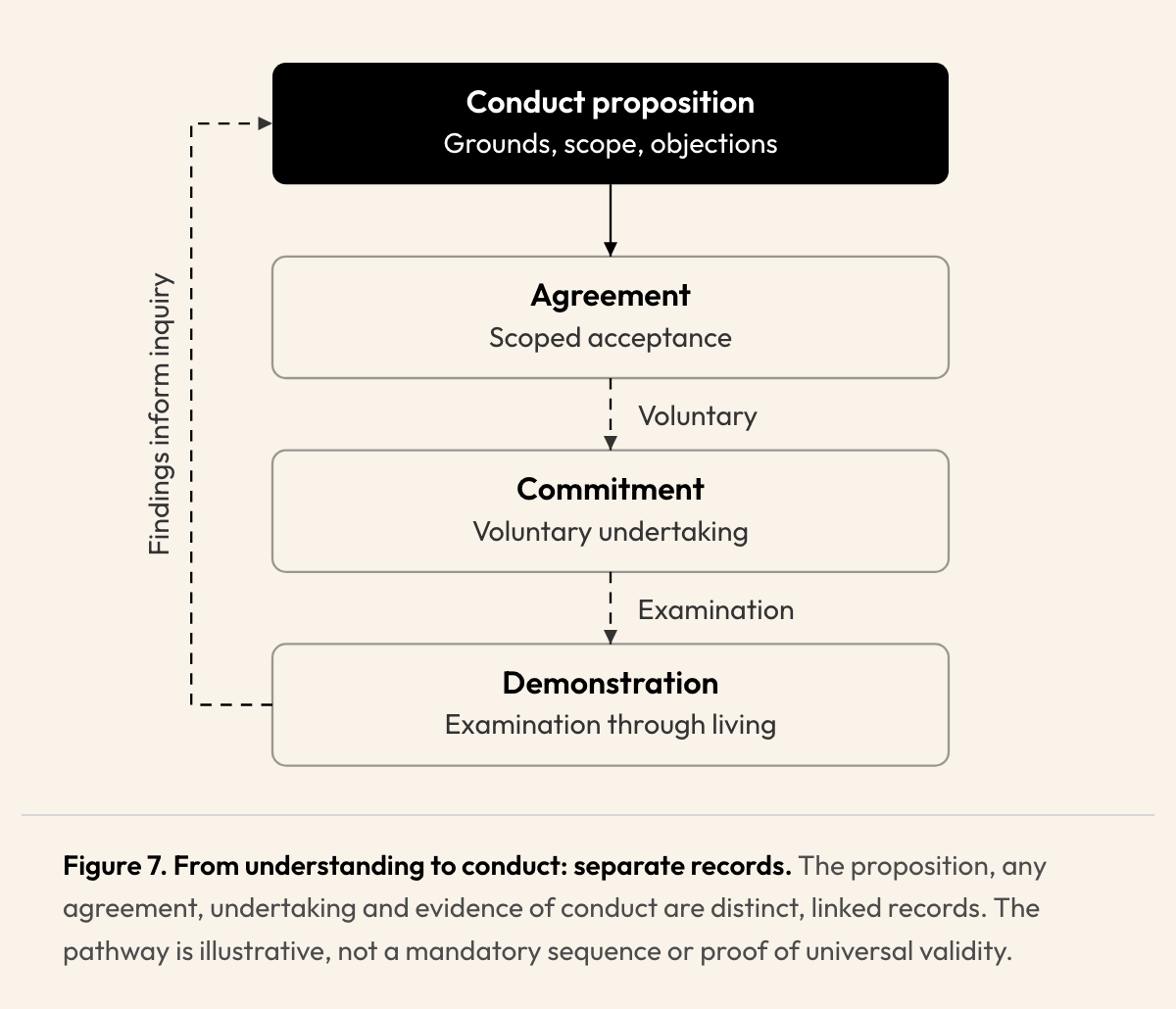
A living Declaration of Human Commitments [Discussion 74–75]
The earlier recommendation was to retain the three lists and create a parallel record of commitments. The subsequent naming decision changes that structural recommendation: the parallel record is now List Four. The proposed Declaration of Human Commitments can be developed as a living, versioned expression of this list, not a separate fifth list, a finished ethical code or a claim to represent the whole human population.
Every commitment in a declaration should be connected to its philosophical foundations, the individual grounds of its signatories, implications for living, methods for examining implementation, remaining objections and unresolved questions, and relevant demonstrations by individuals, families, organizations and communities. It should identify precisely who has agreed or undertaken it and to which version. The declaration must distinguish the agreed content from the scope of its endorsement. A person who has not signed is not thereby considered opposed to the statement or incapable of understanding. An organization's endorsement cannot substitute for the independent understanding or consent of its members.
The declaration can develop incrementally through independent groups and federated publication. No central authority is necessary to approve the existence of a candidate declaration. Different communities can preserve alternative formulations, link their reasoning and compare outcomes. Claims of universal validity remain open to examination; a shared declaration is not an imposed global law, religious obligation or compulsory moral membership test.
The long-term philosophical question [Discussion 76]
Two approaches were considered: establish a minimum set of ethical boundaries acceptable across traditions, or investigate whether universal human conduct can be derived from a universally verifiable understanding of reality. The recommendation was the second as a long-term research direction, while permitting shared commitments to emerge in the meantime. This was not independently ratified as an additional philosophical hypothesis. It remains an open question:
Is there a way of living that is universally appropriate for human beings, not because it has been prescribed by religion, culture, law or authority, but because it is consistent with the nature of reality itself?
If such an understanding is possible, what people will do and will not do could ultimately emerge from that understanding. However, the relationship between descriptive understanding of reality and normative conclusions about conduct must itself be examined. No claim about what ought to be done follows automatically from a description of what exists. Contributors may propose and challenge the grounds that connect them. The initiative must be willing to examine findings that do not support its initial expectations.
Proposed lifecycle of a commitment
The following operational sequence is an editorial working design to make sections 70–78 implementable; it is not an adopted standard.
- 1. Formulate a candidate conduct proposition, identify the domain and explain why it matters.
- 2. Define the relevant terms, scope, conditions, affected parties and foreseeable difficult cases.
- 3. Invite independent responses and grounds, then examine objections using the existing dialogue methodology.
- 4. Record any scoped agreement separately from unresolved differences or questions. Preserve the distinct philosophical grounds.
- 5. Invite voluntary, version-specific undertakings by individuals or by communities within their own responsibilities. No philosophical allegiance or mandatory signature is required for participation.
- 6. Develop appropriate pathways to examine implementation, including the conditions and limits of any observations. Collect only evidence that is necessary and obtained with appropriate consent.
- 7. Review the record over time, including supporting and contrary observations, changes in understanding, partial fulfilment, withdrawal and revisions. A new version requires a new undertaking rather than automatically inheriting old signatures.
This lifecycle links List Four with Lists One, Two and Three and with the broader architecture of education and living demonstration. It does not create a global tribunal to enforce commitments. The protocol may establish standards for record quality while communities remain responsible for their own activities and applicable obligations. Disagreements about a commitment's meaning, justification or implementation are opportunities for continued inquiry.
Proposed safeguards for examining conduct
The initiative should avoid equating declarations with achievements, or evidence of limited conduct with a verdict on a person's entire life. A living demonstration may require sustained observation, contextual explanation and opportunities for independent examination. The interests and consent of affected people matter, particularly in family relationships, education, employment and other settings where power is unequal. Private experiences should not be published or replicated merely because they are relevant to a research question. Evidence should be described with its provenance and limitations, and a person should be able to correct or challenge a record. The means of protecting privacy, preventing harm and permitting withdrawal in a federated system remain open design questions.
Read it offline: the book as a PDF or as Markdown.