Clarity·Essay
Two Buttons: A Unit and a Relationship
A scientific calculator needs only two buttons: the number 1 and one way of relating two things. On why that reminded me of how Madhyasth Darshan describes all of existence.
Written by Achal Agrawal·November 17, 2026·5 min read हिंदी में पढ़ें
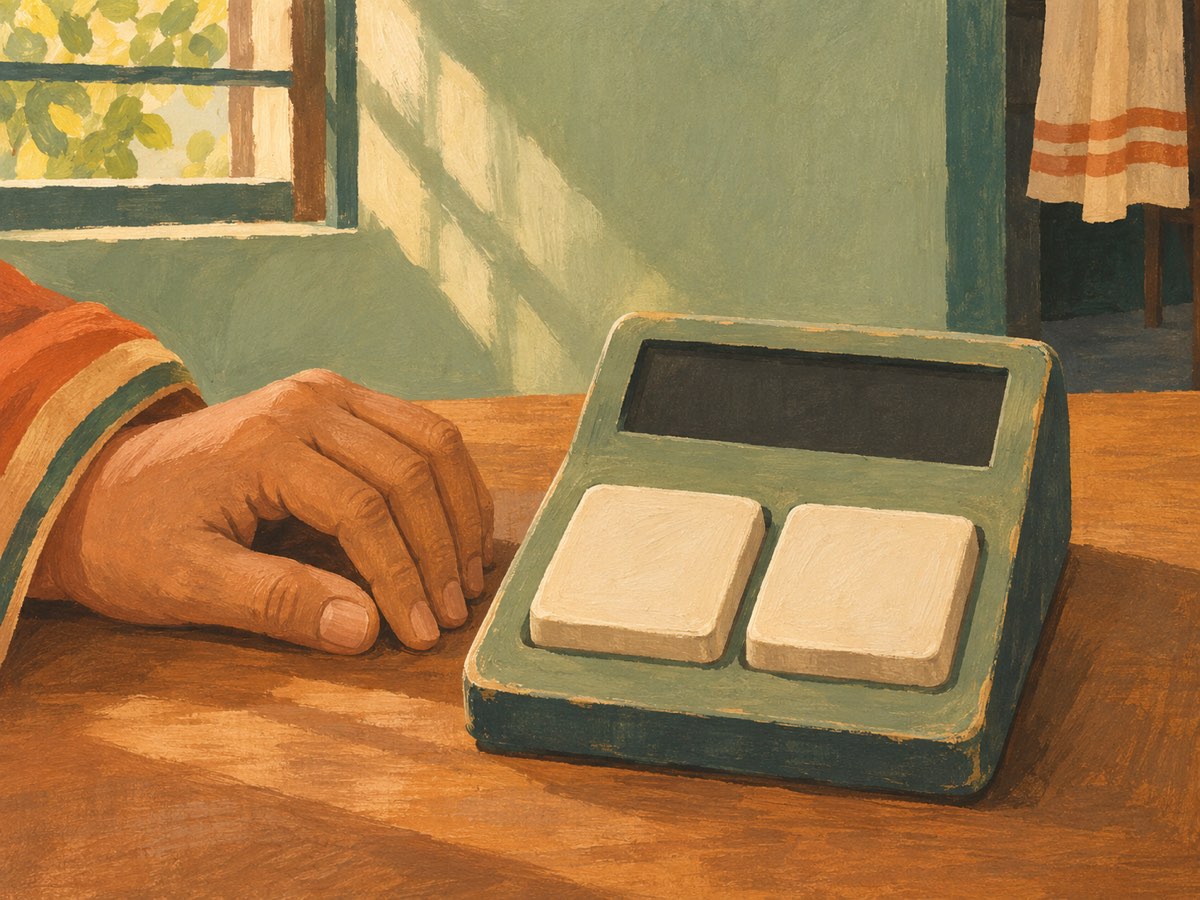
I was watching a video recently in which someone sat with a scientific calculator and asked a simple question. What is the smallest number of buttons this calculator could have and still do everything it does? Not only plus and minus, but sine, cosine, logarithms and powers, and the digits 1, 2, 3, 4 and 8 themselves.
His answer was two.
The first button is 1. A unit. The second he called EML, short for exponential minus logarithm: eml(x, y) = eˣ − ln y. It takes two things and returns one, relating them.
With those two buttons alone, the rest can be built. Press eml(x, 1) and you have eˣ, because the logarithm of 1 is 0. Nest it three times, eml(1, eml(eml(1, x), 1)), and you have the natural logarithm. From there come subtraction, addition, multiplication and division, powers and roots, the constants e, π and i, and sine and cosine. Every formula the calculator knows becomes a tree in which every branch point is the same eml and every leaf is 1.
The result comes from a paper published this year by the physicist Andrzej Odrzywołek, who found the operator by a computer search through the possibilities. He compares it to the NAND gate, the single logic gate from which every circuit in a computer can be built. Nobody would want to use such a calculator; the trees grow very long. That isn’t the point.
What stayed with me was not the cleverness. It was the shape of the answer. One button is a unit. The other is a relationship.
The same two, in Madhyasth Darshan
When I study Madhyasth Darshan, I meet a similar picture of existence as a whole. Shri A. Nagraj describes existence as two realities, always together. One is vyapak vastu, the all-pervading reality that is the same everywhere. The other is nature: countless units, which he says are immersed and soaked in it. Vyapak has no form. Nature, made of units, has form.
Units. The darshan defines a unit as anything bounded on six sides, and the basic unit of nature as the atom. Units are never alone. To show any order, Nagraj writes, there must be at least two atomic parts, because order exists only in coexistence. Atoms come together and become molecules, molecules form larger structures, and small structures form larger ones. Every unit is made of units, and every unit is part of a larger one. A unit is understood fully only with its surroundings. That reads very much like the leaves and branches of the calculator’s tree.
Relationship. The second button is subtler. Vyapak is described as transparent, passing through everything, present everywhere in the same way. Because every unit is soaked in it, every unit is full of energy, and with that comes the tendency to recognise the other and take part in order. Recognition is what lets small units form larger ones. Relationship itself, sambandh, is defined as the connection that comes with coexistence, in the sense of completeness.
So when I say the second button is like vyapak, I mean it loosely. Vyapak is the setting in which units recognise each other, and the laws by which they combine follow from that. Eml is a rule for combining two numbers. They are not the same thing, but they play a similar part. Without them, units stay separate and nothing larger is built.
Why this matters to me
We usually try to understand the world by adding: more buttons, more subjects, more rules, more specialists. The two-button calculator points the other way. If everything on a scientific calculator rests on a unit and a way of relating, perhaps much of what confuses us is clearer if we ask two questions first. What are the units here? And how are they related?
A family is people in relationship. So is a team, and a village. A body is cells in relationship, inside a larger order of air, water and soil. Each one is units, made of units, in something that holds them all. I find that when I look at a problem in this way, it often becomes smaller and easier to understand.
This is my first essay here, and it is a reflection rather than a proof. I would like to keep thinking about it with others. If you see where the parallel holds and where it breaks, write to us.
Limitations
- The calculator result is mathematics and has been checked. The link to Madhyasth Darshan is my own analogy; neither the paper nor the darshan makes it.
- Madhyasth Darshan describes vyapak as the all-pervading, transparent reality in which units are saturated, not as “relationships”. I compare it to the second button for the part it plays, not as its definition.
- The two-button calculator is a demonstration, not a better calculator. Simple functions become very long expressions, and some of them pass through complex numbers on the way.
References
- Andrzej Odrzywołek, “All elementary functions from a single binary operator”, arXiv:2603.21852 (2026)
- Shri A. Nagraj, Samadhanatmak Bhautikvad (समाधानात्मक भौतिकवाद), pp. 24, 26, 38, 40
- Shri A. Nagraj, Manav Karm Darshan (मानव कर्म दर्शन), pp. 51, 52, 103
- Madhyasth Darshan paribhasha: vyapak vastu (p. 181), ikai (p. 43), sambandh (p. 207)