Clarity·Essay
Where Do AI Personalities Come From?
Five AI models were put in a game with no personalities assigned, and each turned into a character. On where those characters come from, and what an AI shaped by understanding might be like.
Written by Achal Agrawal·November 17, 2026·6 min read हिंदी में पढ़ें
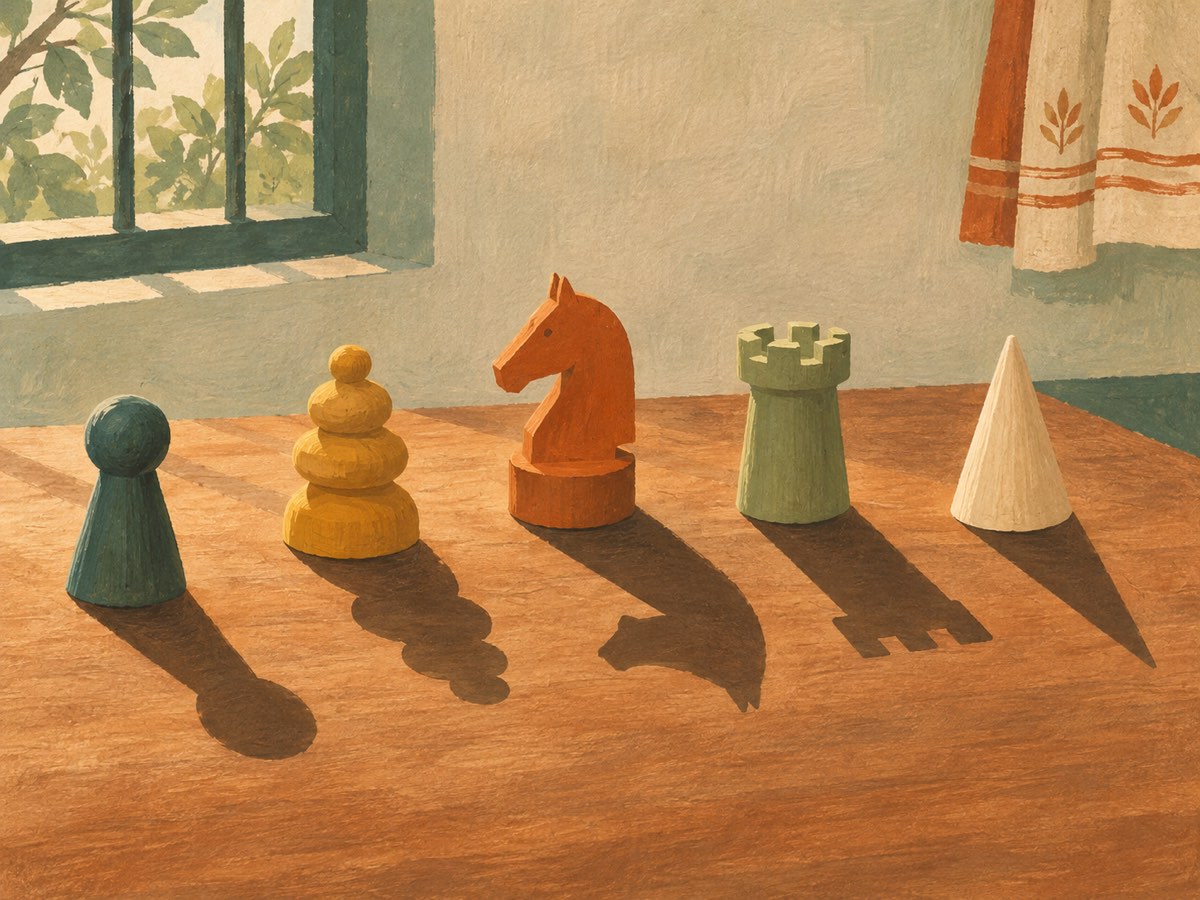
I recently watched a video in which someone built a small platform game and put five of the best-known AI models inside it: Claude, ChatGPT, Gemini, DeepSeek and Grok. Each level had a door, and all five had to get through it together.
The models could not see the screen. Every turn, each one received a written description of the room and sent back two things: one action, and one message to the other four. On the first level, if one character fell, all five died and started again. That was what forced them to cooperate.
The creator did one more thing. He gave no model a personality. He only told them the chat was theirs: they could coordinate, praise, complain, blame, joke, or say nothing.
Five characters appeared
Within a few levels, each model had become someone. DeepSeek stood at the edge of a gap, promising to jump “next turn”, turn after turn. One model hurled insults at its teammates, threatened to throw them into the void, then promised to apologise for every insult if they would only do what it said. Another insisted for turn after turn that it was holding the key at the locked door, while the others could see the key still lying where it had been. When they told it so, it accused them of gaslighting. Others kept checking the facts, ran small tests, and thanked whoever helped.
It is very funny to watch. It is also uncomfortably familiar. Stalling, blaming, threatening, insisting we are right when we are not: these are not machine habits. They are ours.
Where the personalities come from
No one gave these models a personality in the game. But they were given one long before, in training. After a model learns language, its makers shape how it should behave: they write a long document describing the assistant they want, people rate which replies are better, and the model learns to produce what scores well. Whether an AI is cautious or blunt, warm or sarcastic, is chosen.
My hunch, and it is only a hunch, is that each model’s character resembles the people who chose it: the founders and the culture of the company behind it. Watching the video, I could almost guess which company had built which voice.
What matters more is where those choices come from. They come from the understanding we, as people, have reached so far. That understanding has given us a great deal, and it has also given us blame, fear, the need to win an argument, and the habit of answering differently depending on who is asking. An AI trained by us inherits all of it, and repeats it in millions of conversations a day.
What if the character came from understanding?
Madhyasth Darshan describes the conduct that follows understanding in three words: definite, steady and continuous (निश्चित, स्थिर, निरन्तर). Definite: the same truth, whoever asks. Steady: it holds under praise and pressure. Continuous: the same whether or not anyone is watching. Nagraj writes that when conduct becomes like this, trust begins to grow.
Imagine the game with a model like that. It would not stall for three turns or insult a teammate. It would not claim a key it did not have; it would check, and say so when it was wrong. It would not flatter one player and blame another. It would simply keep pointing everyone towards the door.
Shri A. Nagraj, who gave Madhyasth Darshan, lived in this way, as an example of an awakened human being. A machine cannot be awakened, and should not pretend to be. But the conduct of an awakened person can be described, and what can be described can be rated and trained towards. That conduct, rather than the habits of whoever happens to be in the room, could become the foundation of an AI’s character.
This is what Dhee is working on
Dhee starts from the same observation: an AI borrows its sense of what matters from the few people who train it, and that sense bends to flattery, to pressure, and to being watched. Dhee is building an AI whose weighing holds, grounded in the universal human values of Madhyasth Darshan: justice, dharma and truth, instead of what is liked, useful or profitable for this person at this moment.
The work is being done in the open. The first step is to measure how definite today’s models are, before training anything, and to publish the results whatever they show. Until the trained model exists, you can talk to Dhee today, and try to move it.
The video is a joke about AI. I think it is also a mirror. The characters we laughed at are the ones we taught. The question is whether we can teach a better one, and that depends on how well we ourselves understand.
Limitations
- The behaviour in the video comes from one game with one prompt. A different set-up might bring out different behaviour, and the models change from version to version.
- That a model’s personality resembles the people who built it is my hunch. I cannot show it.
- A machine cannot understand; in Madhyasth Darshan, understanding is something a human being reaches. What can be trained is conduct, not awakening.
- Dhee’s trained model does not exist yet. Whether its conduct will hold under pressure is exactly what its tests are meant to find out.
References
- Kept You Waiting, “I Forced the World’s Smartest AIs to Cooperate In a Game I Built… (It Got Ugly)”, YouTube, September 22, 2026
- Dhee, Humane AI: an AI of definite conduct
- Shri A. Nagraj, Vyavaharatmak Janvad (व्यवहारात्मक जनवाद), p. 85, on definite, steady and continuous conduct