Clarity·Essay
What Is All This Effort Meant to Change?
“One more improvement, and it will work.” On people, results and time: what should be different because we did this work, and the clarity it asks for before we invite others to join.
Written by Subhash Trivedi·November 18, 2026·6 min read हिंदी में पढ़ें
“One more improvement, and it will work.”
I can see how a project could continue for years on the strength of that sentence. We find another problem, make another adjustment, and give it more time. There is always something that could be better.
Sometimes the next improvement removes a real obstacle. But if we cannot explain how it connects to the result we want, we can keep extending the work without getting closer to what we hoped to achieve. Eventually, the time already spent becomes the reason to continue.
A recent discussion about projects brought me back to a question:
What, exactly, should be different because we did this work?
We gather our actions around things we want to make possible. Some become formally named projects. Others take shape in families, schools, and the responsibilities we accept. In each case, we are giving part of our lives to something.
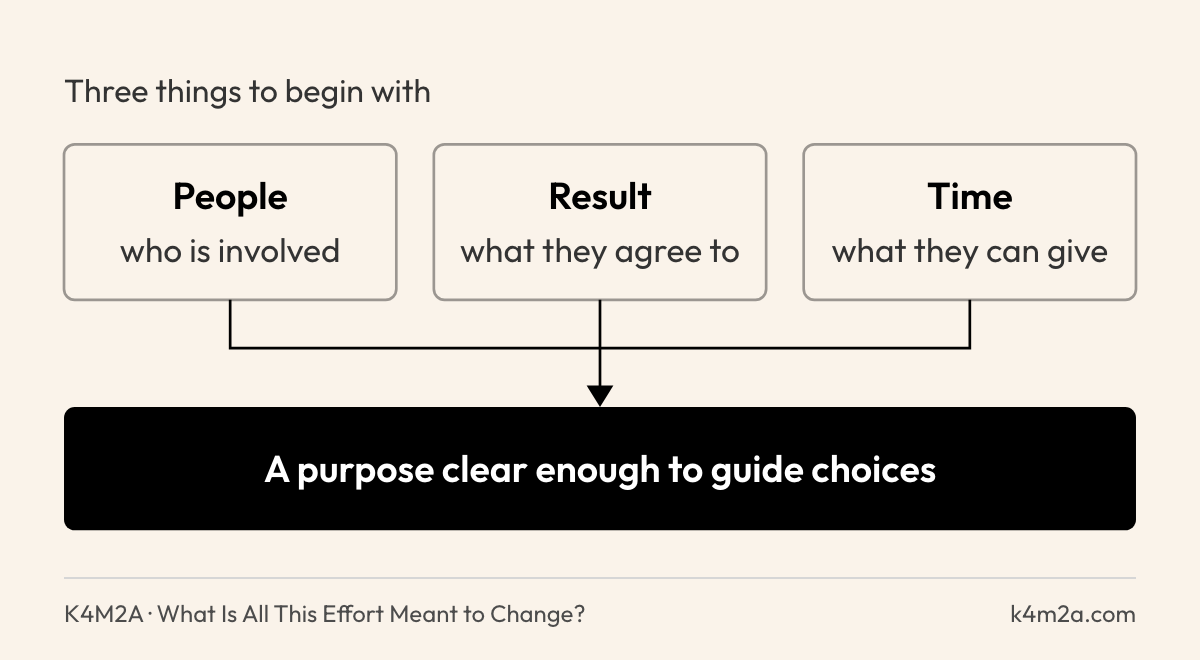
I find it useful to begin with three things: the people involved, the result they agree to work towards, and the time they are prepared to commit.
Consider a group of people who want to build a good school.
Agreeing that the school should be good is a beginning. We still need to understand what we mean by that. What should children experience there? What should they become able to understand and do? What would tell us that the school is fulfilling its purpose?
The people involved will also have personal needs and hopes. A teacher may want a dependable income. Someone may hope their contribution will be recognised. These do not automatically conflict with creating a good school. The important question is what happens when priorities compete. If something brings recognition but takes attention away from what children need, how will we decide?
A shared goal needs enough clarity to guide those choices. Otherwise, we may work sincerely while pulling in different directions.
This is where design becomes important.
I think of design as understanding how our effort can produce a worthwhile result, with care for the time, energy, and resources it requires. A plan should help us explain why a particular action is necessary and what we expect it to make possible.
In our discussion, we considered teacher training. One possibility is to spend 100 hours training the staff of a single school. Another is to use those hours with five teachers from each of ten schools, with the intention that they help their colleagues learn.
The second approach appears to extend the reach of the same training time. But that is only the beginning of the design.
Those teachers need to understand the material well enough to explain it. They need time with their colleagues. They may need support when questions arise or when something proves difficult to use in a classroom. All of that is work, even if it does not appear in the original 100 hours.
I have to count the effort required across the whole project. If something looks efficient because I have left other people’s work out of the calculation, I have not yet understood what the project requires.
The result we would need to look for is what teachers can now do in their classrooms and what children are able to learn. A larger number of participants, by itself, would not answer that question. Whether this design works is something we would have to find out.
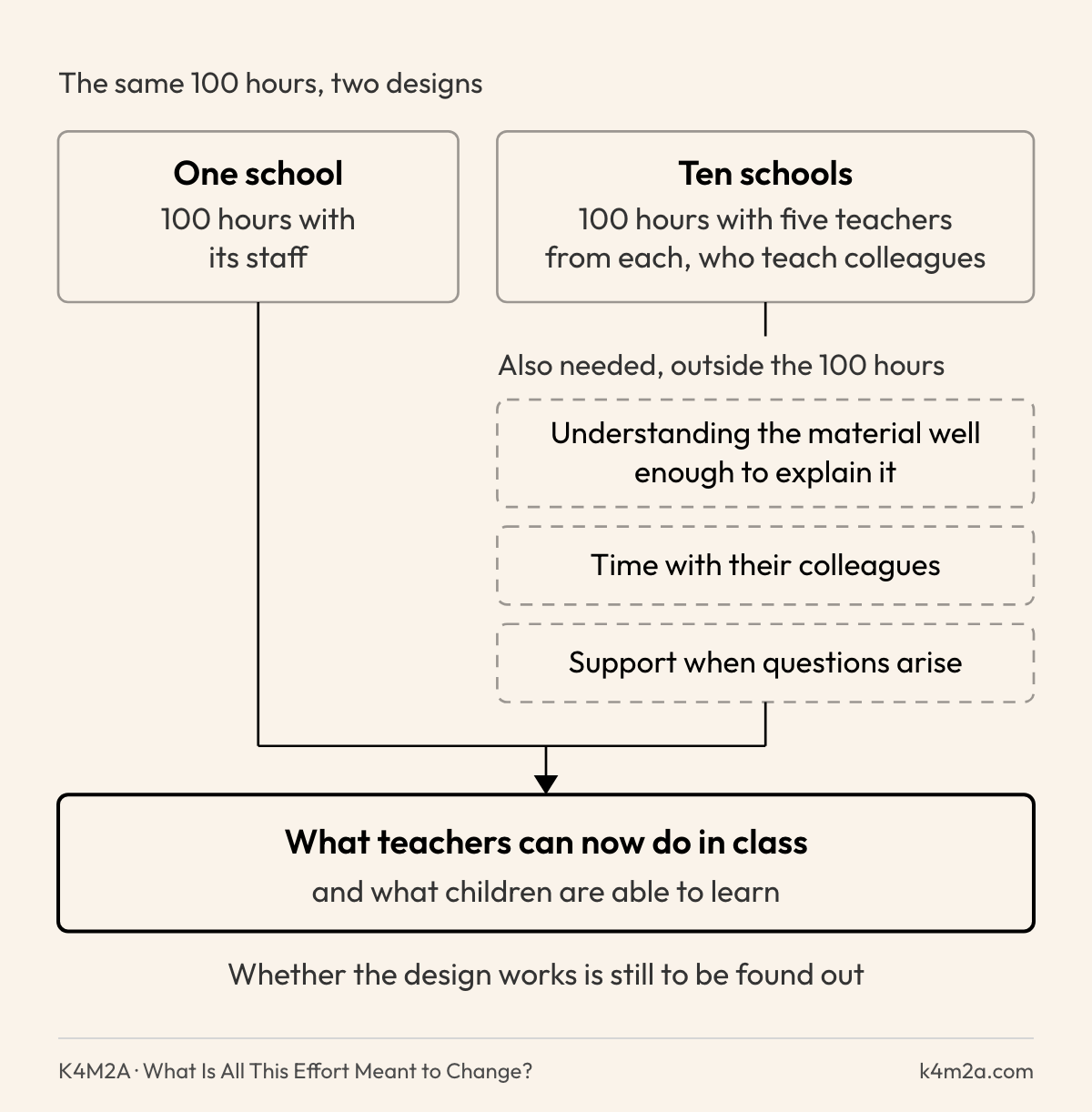
Thinking this through makes the work visible. Preparing the material, working with teachers, supporting their colleagues, and observing what happens in classrooms become connected parts of the project. Some can happen together. Others depend on an earlier step being completed.
This is the kind of clarity I want before asking more people to join.
We do not need to know every detail in advance. Some details will become clear only through doing the work. But we should be able to describe the contribution we are asking someone to make, how it connects to the purpose, and what remains uncertain.
Writing the work down before the team is complete can help. A person considering joining can see something they might take responsibility for. They can also tell us where our estimate is unrealistic or where an important part is missing.
Then comes an equally honest conversation about time.
“I can help twice a week” may express sincere intent. It becomes more useful when we agree on when that time is available and what can reasonably be done within it. A regular time gives the commitment a place in our lives. If it repeatedly disappears, we need to reconsider the commitment rather than keep planning as though the time exists.
I want trust to grow through that honesty.
Sharing a purpose does not remove differences in capacity, competing responsibilities, or unexpected difficulties. People can care deeply about the work and still overestimate what they can take on. What helps is knowing what has been agreed, hearing early when something changes, and being able to adjust together.
These questions also apply to me.
I am asked why I take on so many projects. I see connections between them: schools, families, the things we make, and the conditions in which people live. Through K4M2A, I am trying to contribute to a life with more understanding, trust, and responsibility towards the earth.
But seeing a connection in my mind does not automatically make the work coherent.
I still need to explain what each project contributes. I need to be honest about the time I can give it and the time I am asking from others. If several projects depend on attention I do not actually have, describing their shared purpose will not resolve the difficulty.
Some work may need to wait. Some ideas may need further thought before becoming commitments. I want to be able to recognise that without treating every pause as a failure of ambition.
The hope behind these projects is quite ordinary. Children should be able to learn with understanding. Families should be able to rely on one another. We should be able to meet our needs in ways that allow the earth to continue supporting life.
Giving that hope a practical form asks for careful work. It also asks us to remain willing to question the work we have chosen.
When a result does not come, I want to look more carefully before asking everyone to try harder. We may need more practice, a different design, or a clearer understanding of the problem itself.
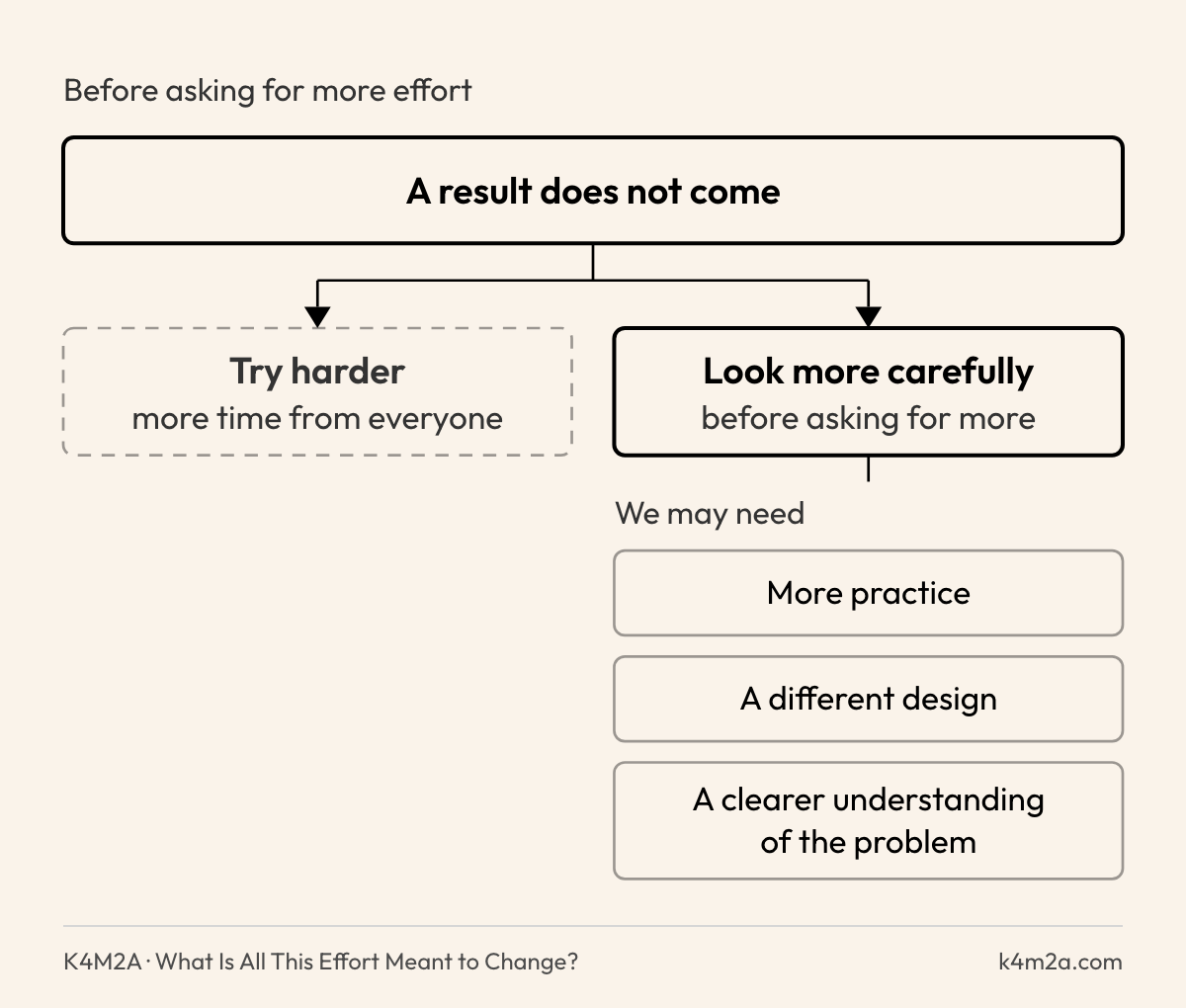
Before asking for more time, I want us to understand better what we are giving it to.
Limitations
- This comes from my own experience of projects and one recent discussion, not from a study.
- The teacher-training design described here has not been tried. Whether it works is still to be found out.